our approach aimed at maximizing productivity & efficiency.
Founder, SINKHAN MACHINE Inc.
Overview
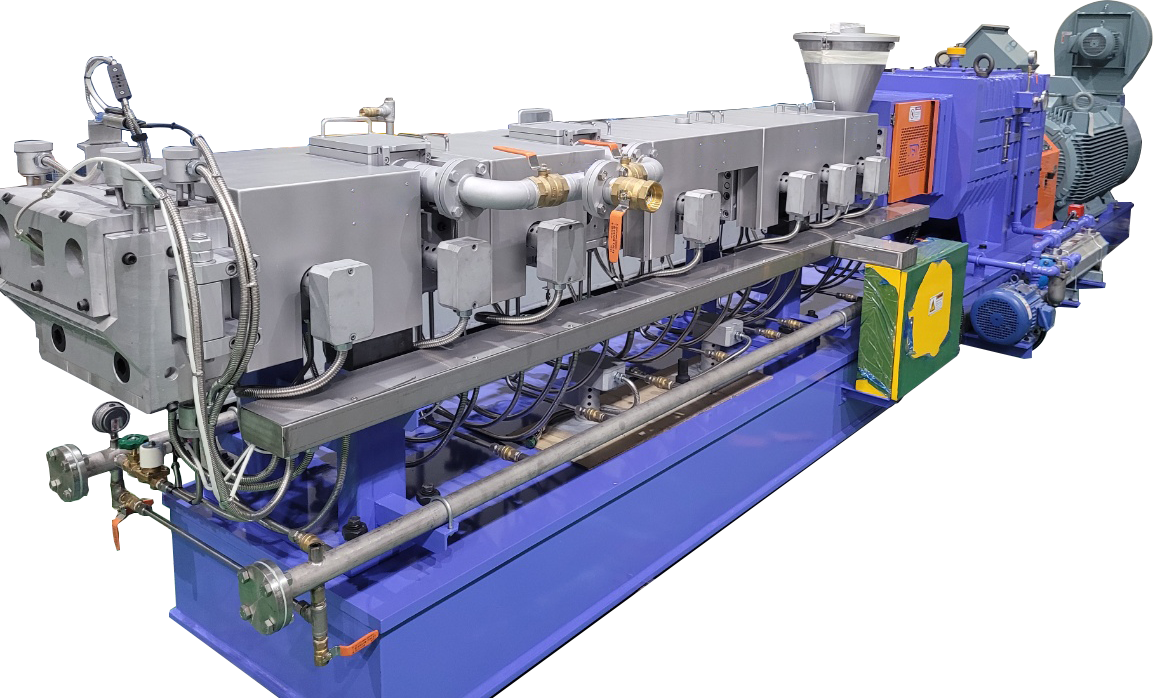
A Twin Extruder (Twin Screw Extruder) is a high-performance extrusion system featuring two intermeshing screws rotating inside a single barrel. Compared to single screw extruders, it offers superior mixing (compounding) performance and precise thermal control, making it an essential solution for processing complex polymer blends, filled plastics, and functional additives.
-
Co-rotating: Delivers high shear stress and excellent self-wiping capabilities, ideal for compounding and dispersion.
-
Counter-rotating: Provides high pumping efficiency and uniform pressure, widely used for PVC pipe and profile extrusion.
Key Features & Advantages
-
Exceptional Mixing & Dispersion: Intermeshing screws ensure homogeneous blending of base polymers, fillers (e.g., glass fiber, talc), and additives.
-
Self-Wiping Capability: Continuous scraping between screw flights prevents material stagnation, degradation, and thermal damage.
-
Superior Venting & Degassing: Multiple vent ports efficiently remove moisture, volatiles, and trapped air to prevent internal voids and defects.
-
Modular Screw & Barrel System: Screw segments (conveying, kneading, reversing) can be reconfigured based on specific polymer processing needs
application
Reinforcing PA, PBT, or PET with glass fiber or flame retardants for automotive and electronic components.
predictive machines
Fusce dui est ultricies nec ultricies acd porttitor quis tellus ned.
certified factory
Fusce dui est ultricies nec ultricies acd porttitor quis tellus ned.
service related FAQ’s
Lean manufacturing is a systematic approach aimed at minimizing waste while maximizing productivity and efficiency.
Robotics improves manufacturing by increasing efficiency, precision, and safety, while also reducing labor costs and repetitive tasks.
Predictive maintenance uses data analysis and machine learning to predict when equipment failure is likely to occur, allowing for maintenance to be performed before issues arise.
Key components include sourcing, production, inventory management, distribution, and customer service.
Industry 4.0 refers to the integration of digital technologies such as IoT, AI, and data analytics into manufacturing processes to create smart factories.